
Omar Hayat Mahal, also spelt Umer Hayat Mahal, and alternatively known as Gulzar Manzil, is an early 20th-century wooden haveli mansion in Chiniot, Pakistan.
The mansion was started in 1923, and was completed by 1935. The mansion, originally 5-storeys tall, was built by Sheikh Omar Hayat - a Chinioti businessman who had 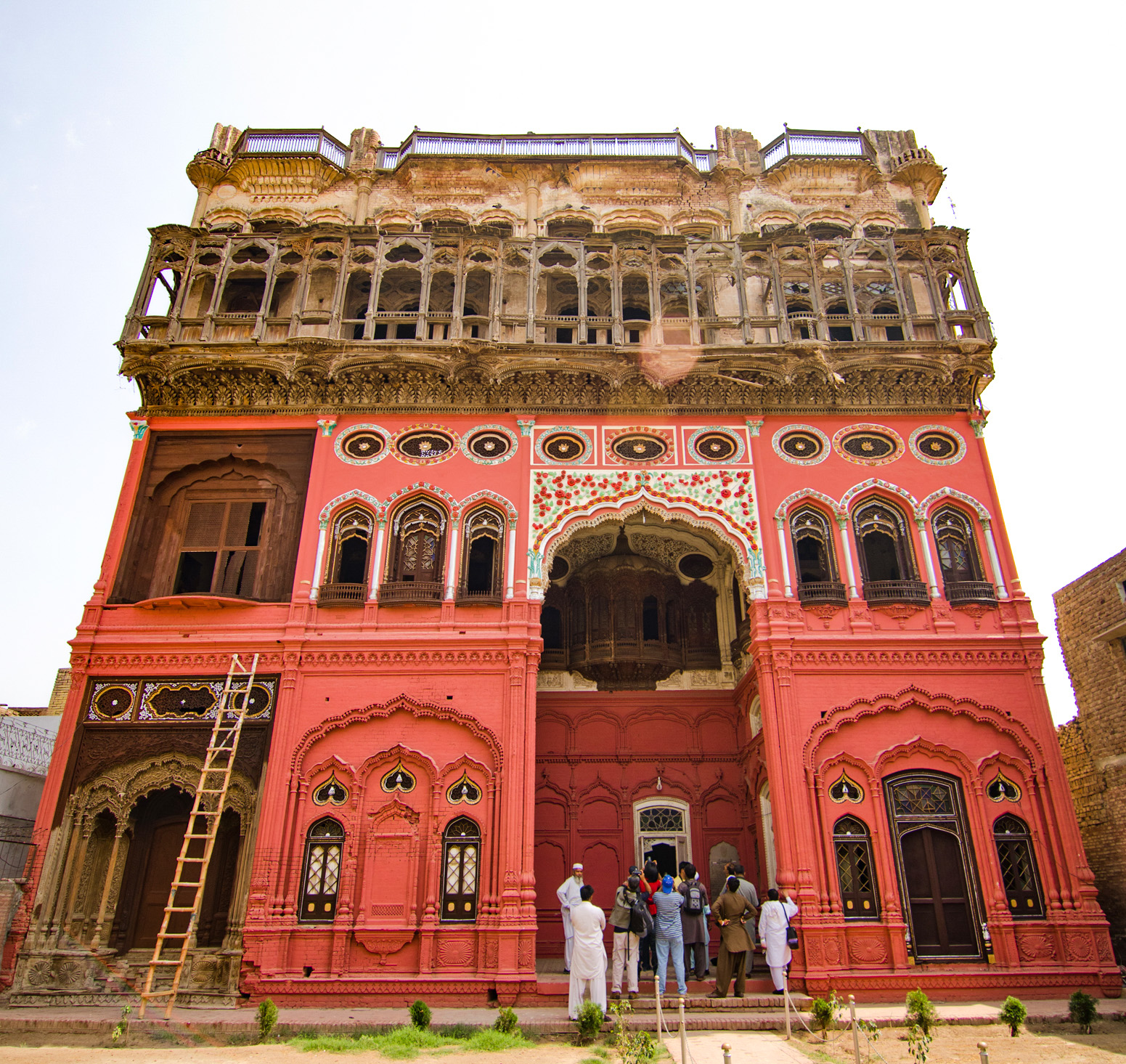
made his fortune in Calcutta. The edifice displays outstanding examples of Chiniot's local woodworking style, and has been described as an "ornament" of a building
on account of its lavishly decorated interior.
Sheikh Omar migrated from Chiniot to Calcutta in the late 19th century after being ostracised for marrying against his family's will. Large numbers of Chiniot's Sheikh
tribe had settled in Calcutta during the British era.
Sheikh Omar's first son, Gulzar, was born in 1920, prompting Sheikh Omar's decision to return to his hometown, where he decided to construct a magnificent palace
that would feature the best of Chiniot's craftsmanship.
Syed Hassan Shah was assigned the task of palace's construction. He gathered Chiniot's best artisans, as well as from different places, who continued working day and
night for 10 ten years. Rahim Bakhsh Pirjha and Elahi Bakhsh Pirjha, masters in the manabat kari style of wood carving, carried out much of the mansion's woodworking.
Ahmad Din, completed the brickwork, while the celebrated artist Niaz Ahmad Jalandari did the stucco-work. Another celebrated artist, Jan Muhammad, painted the
mansion's frescoes.
The mansion was habitable by 1930, and described as a 'local wonder' by the British authors of the District Gazeteer of Jhang. It was completed in 1935 - at a cost of
200,000 rupees. Sheikh Omar died shortly after its completion in 1935.
Sheikh Omar Hayat's only son, Gulzar, was married in the mansion in an extravagant ceremony in 1937. Gulzar was found dead in the palace the very next day of his
marriage, possibly as a result of inhalation poisoning as a result of large volumes of coal that had been burnt for the celebration. He was buried in the courtyard
of the ground floor of the palace, alongside with the grave of his mother, who later passed.
Mr Hayat's relatives abandoned the mansion, associating it with bad luck. Servants continued living for a couple of years, though no family members laid claim to the
building. In 1940, the Anjuman-e-Islamia organisation opened a school in the building. An orphanage was established in 1948 Sheikh Muhammad Amin, though it was shifted
in 1950, leaving the building abandoned once again. Local scavengers dismantled some of the mansion's decorative elements, and sold them to collectors in other cities.
Two levels of the mansion was removed in the 1970s due to its state of dangerous disrepair, while another level had to be abandoned following severe rains in 1993.The
building was brought under government control in 1989, with large portions repaired by the mid-1990s with funds raised by the local community. The mansion is now
used a cultural centre and library.